
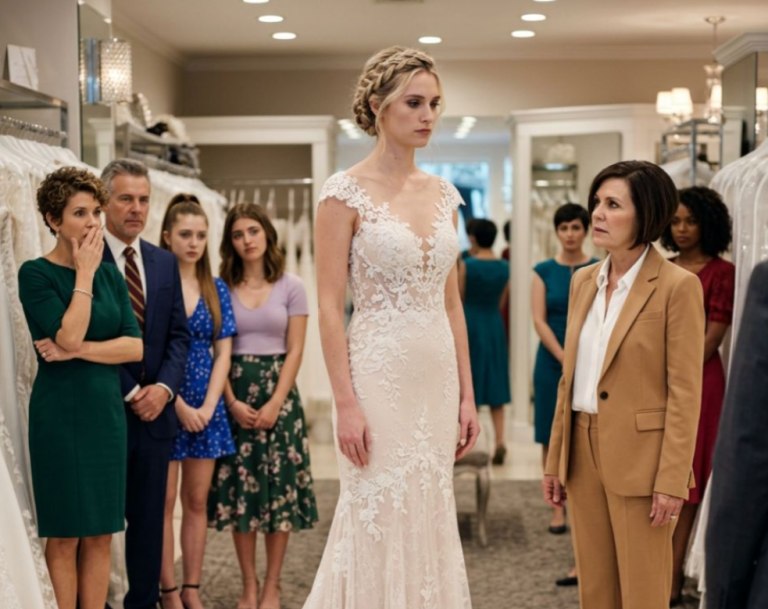
Then I asked to try on a dress.
This one was entirely different—clean, sculptural, uncompromisingly white. No lace asking permission to be admired. No softness begging to belong.
When I looked at myself in the mirror, I did not see a bride.
I saw myself.
Whole.
Maybe not claimed by bloodline.
But no longer waiting to be claimed at all.
I bought the dress.
Three months later, I wore it to the Fortune 500 gala. I arrived alone, dressed in white silk, with no veil and no explanation. When a journalist asked whether recent events had changed my view of New York society, I answered, “Society remains what it has always been: a room full of people trying to decide whether they believe value can be learned or only inherited.”
Later that night, on a terrace above Fifth Avenue, Eleanor Price—one of the few older women in my field who never mistook mentorship for branding—told me I looked like a woman who had finally stopped asking for admission.
She was right.
The Whitmores faded from my life after that. Derek moved to Boston. Harold’s firm survived in smaller form. Constance became noticeably quieter in the circles she once dominated. People turned the whole thing into a social anecdote, but I refused to let it become that simple. It had never really been about a dress. Or about white. It had been about the belief that some people are born legitimate and others should remain grateful for whatever scraps of acceptance they receive.
By autumn, I turned some of the emotional wreckage into something useful. I established the Ashford Transition Initiative with a five-million-dollar endowment to support young adults aging out of foster care: housing, emergency grants, mentorship, and scholarships. No essays demanding trauma packaged as inspiration. Just practical support from people who understood how expensive instability can be.
At the first advisory dinner, I looked around the table and saw not victims performing resilience, but adults who had built sturdy lives out of fracture. No one asked whose family stood at which side of the room.
At Thanksgiving that year, I hosted dinner.
A real dinner.
Loud. Overfull. Uncurated. Warm.
And no one needed permission to belong.
