
“Sí, el que se acaba de retirar de la fusión de tu padre.”
No podía entender por qué nunca se lo había contado. Podría haberle explicado: que quería saber si era capaz de amar a una mujer antes de calcular su valor, que la privacidad era uno de los pocos lujos que nos quedaban a personas como yo, que la riqueza transforma a los hombres de maneras que rara vez admiten.
Instead I simply said, “Because what I have is not the most important thing about me.”
He said his father’s firm was falling apart, that everything had been built around this deal.
Everything.
The word echoed.
Everything built around a transaction.
Nothing built around decency.
Then I removed the engagement ring and placed it on the desk.
“The wedding is off,” I said.
He stared at it as if refusal might make it disappear.
“You can’t mean that.”
“I do.”
“You’re ending this because I froze in one bad moment?”
“I’m ending it because one bad moment exposed every good one as unstable.”
He asked what he could do.
Yesterday, that plea might have moved me.
Today, it only tired me.
“I wanted you to defend me without instructions,” I said.
Then I asked him to leave.
When he said he loved me, I believed that perhaps he did—in the limited way he knew how. But I had learned long ago not to trust love that arrives too late to prevent harm and too early to accept responsibility. I pressed the intercom and had security escort him out.
Minutes later, Constance Whitmore arrived demanding to see whoever was responsible.
When she saw me standing in the executive corridor, the color drained from her face.
“You,” she said.
“Inconveniently, yes.”
She called it impossible. Said I had lied. Said I had let them believe the wrong things.
“No,” I told her. “I let you reveal yourselves.”
She demanded to know whether I understood what I had done.
“Yes,” I said.
She said Harold’s firm might collapse.
“That is a risk.”
She accused me of making corporate decisions over a personal slight.
I nearly admired the boldness.
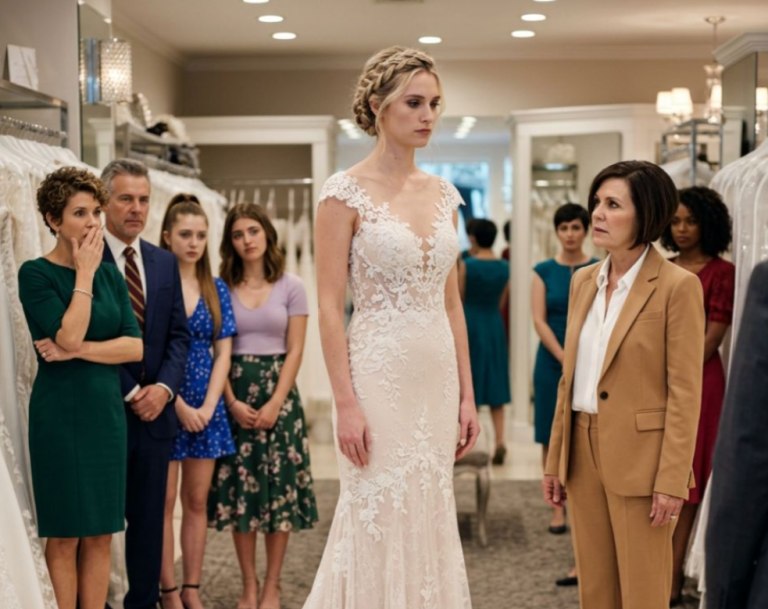
“Yesterday,” I told her quietly, “you announced in a bridal salon that I was unworthy of white because I grew up without a family. Today you’re here arguing that I should save yours.”
That is when fear finally appeared beneath the pride. For the first time, she understood not just that she had insulted me—but that the orphan she had mocked now held the power she thought belonged only to people like her.
She asked what I wanted.
The answer surprised even me in its simplicity.
“I want you to remember this feeling,” I said. “The moment you realized that the woman you tried to humiliate was never diminished by your opinion—only clarified by it. I want you to remember that the person who brought your family to its knees was the orphan you considered unfit to wear white.”
Then she whispered, “Please.”
And still, nothing changed.
I had security escort her out. At the elevator, she said I would regret it.
“Maybe,” I replied. “But I’ll regret it with excellent views.”
The corridor eventually returned to normal. That is what power does. It keeps moving. There were calls, disputes, approvals, and revisions waiting. The day went on. Only later, back in my apartment by the fire, did the silence become loud again.
And in that silence, childhood returned.
People like to imagine self-made women emerge untouched by what they survived. That enough wealth, polish, and discipline can erase the old hunger. It does not. It simply learns how to sit quietly in expensive clothes.
Then, one afternoon in a bridal salon, someone speaks with the right cruelty, and the old hunger stands back up.
That evening I received a text from Miranda, the consultant.
She wrote that I had been the most beautiful bride she had ever seen in that dress, and that some people simply did not deserve to witness certain kinds of grace. I replied that her message meant more than she knew.
That kindness struck me harder than all the day’s larger events. Kindness from strangers carries no entitlement, no history, no debt. It simply arrives. And because of that, it can feel almost unbearable.
The next few weeks were brutal for the Whitmores. Their firm tried to control the narrative. Rumors spread. Partners began leaving. Calls went unanswered. Derek reached out repeatedly. I did not respond. Constance sent three handwritten apologies, each softer than the last. I read them. I filed them away. Understanding is not the same thing as repair.
I returned the ring through counsel. I paid every wedding vendor in full because I do not ruin working people to punish the rich. I declined all press requests. Silence had built my life. It could protect it too.
Eventually spring came, and with it the slow realization that healing does not arrive like dawn. It comes in unnoticed evenings—when you realize you have gone a full day without thinking of the person who hurt you.
One afternoon in April, I found myself outside Bellmont Bridal without planning it. I went inside. Miranda met me with the same genuine warmth she had shown before. I handed her an envelope containing a note and a check large enough to cover a year of design school, something my assistant had learned she dreamed of pursuing.
“You were kind when it cost you comfort and gained you nothing,” I told her. “That isn’t nothing.”
